
A Ravangla Tour Done Right: Why One Day Is Not Enough
Most people treat Ravangla as a lunch stop. They roll in from Gangtok or Pelling, walk a loop around the giant Buddha, buy a cup of tea, and drive on. I did a Ravangla tour exactly that way once, years ago, and it is the reason I keep going back to do it properly. This small town at 7,000 feet, sitting at the base of Maenam hill between the Teesta and Rangit valleys, holds enough for two or three unhurried days, and the best of it is what the day visitors never reach.
Give Ravangla a real stay and it opens up. A red panda forest you climb into at dawn, three very different monasteries within a short drive, a hot spring at the bottom of a valley, and Sikkim’s only tea garden twenty minutes away. Here is how I would plan a Ravangla tour that earns its place on the itinerary rather than passing through.
Where Ravangla is and how to reach it
Ravangla sits in South Sikkim at about 7,000 feet, at the foot of Maenam hill. From Gangtok it is roughly 65 km, around three hours by road. From Pelling it is a similar distance, which makes Ravangla a natural halfway halt between the two. New Jalpaiguri railway station (NJP) and Bagdogra airport are about 110 km away, four and a half to five hours of driving, and Namchi is only around 30 km.
Shared jeeps run from Gangtok and Jorethang, but the sights around Ravangla are spread out, so a private cab for a day or two saves a lot of waiting. On permits, South Sikkim is not a restricted zone, so Indian travellers need nothing special. Foreign nationals need an Inner Line Permit for Sikkim, easy to arrange online or at the Rangpo checkpost.
Buddha Park, the sight everyone comes for
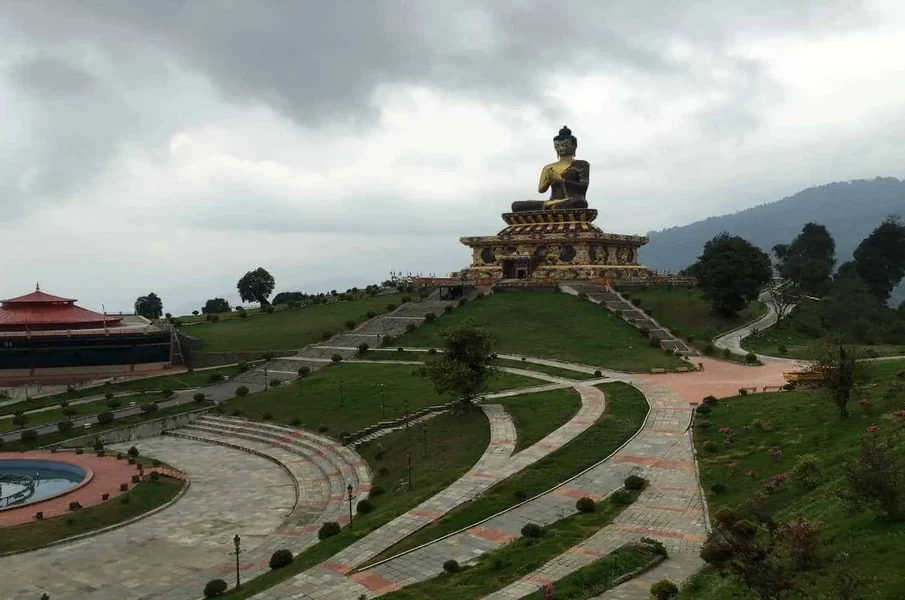
Tathagata Tsal, better known as Buddha Park, is built around a 130 foot statue of the seated Buddha, raised between 2006 and 2013 and consecrated by the Dalai Lama. Entry is around 50 rupees for Indians and 100 for foreign nationals, open roughly 9 am to 5 pm (as of early 2026). Inside there are landscaped walkways and the small Cho Djo lake, and the whole thing takes an hour and a half to two hours.
An honest word: at midday, with tour buses in, the park can feel more like a manicured monument than a place of quiet. Come in the first hour after opening or the last before closing. The light is better, the crowds thin out, and the calm the place is meant to have actually returns.
The monasteries most tours skip
New Ralang Monastery, properly Palchen Choling, lies about 10 km from town. It belongs to the Kagyu school, houses close to 500 monks, and comes alive during the Pang Lhabsol festival in late summer, when masked dancers honour Kanchenjunga as the guardian deity of Sikkim. If you can time your trip to it, do. Nearby sits the older Ralang Monastery, quieter and more atmospheric.
The one almost nobody visits is the Bon Monastery near Kewzing, one of only two Bon monasteries in India. Bon is the pre-Buddhist tradition of the Himalayas, and the murals here follow its own iconography. There is rarely another traveller around, which is exactly why it is worth the short detour.
Maenam Wildlife Sanctuary, the reason to stay an extra day
This is what tips Ravangla from a stop into a proper base. The trek up to Maenam peak, at about 3,140 metres, is roughly 9 km of uphill through oak, magnolia, and rhododendron, four hours up and two back down. This is red panda country, though sightings are rare, along with barking deer and goral. You need a forest permit, arranged at the range office in Ravangla.
Push on past the summit to the Bhaley Dhunga viewpoint, a cliff edge that drops away toward the plains. On a clear morning Kanchenjunga fills the whole northern sky. Start at first light, because the cloud usually rolls in by late morning, and take a local guide. This is a real climb, not a casual stroll.
Ralong hot spring and Temi tea, easy add-ons
About an hour’s walk down from the Ralang area sits the Ralong hot spring, a set of sulphur pools with basic huts, busiest in winter when locals come for the traditional soak. Twenty minutes by road takes you to Temi Tea Garden, the only tea estate in Sikkim and worth a morning of its own. The villages of Kewzing and Borong, both close by, are good bases if you would rather stay in a homestay than a hotel.
Best time for a Ravangla tour
Two seasons stand out. March to May brings the rhododendrons out on Maenam and mild, walkable weather. October and November give the clearest Kanchenjunga views of the year and line up with festival season. The monsoon, June to September, turns everything green but brings leeches on the trek and landslide risk on the approach roads. Winter is cold, crisp, and very quiet, with the odd fall of snow.
Where to stay
Ravangla has a spread of small hotels and guesthouses, roughly 1,300 to 2,900 rupees a night, with the sunrise-view rooms worth booking ahead in peak season. For something more local and usually cheaper, the homestays in Kewzing and Borong put you on a working farm with home-cooked meals. Give yourself two nights minimum. Three if you want the Maenam trek without rushing it.
Ravangla tour FAQ
How many days do you need in Ravangla?
Two to three. One day covers Buddha Park and a monastery, but the Maenam trek, the hot spring, and Temi tea need a second and third day.
Is Buddha Park worth visiting, and what is the entry fee?
Yes, especially early or late in the day. Entry is around 50 rupees for Indians and 100 for foreign nationals, as of early 2026.
What is the best time to visit Ravangla?
March to May for rhododendrons and mild weather, or October to November for the clearest Kanchenjunga views and the Pang Lhabsol festival.
Do you need a permit for Ravangla?
Indian travellers need no permit for Ravangla itself. Foreign nationals need an Inner Line Permit for Sikkim. The Maenam trek needs a separate forest permit.
How far is Ravangla from Gangtok?
About 65 km, roughly three hours by road.
Stitching Ravangla into a wider South Sikkim route, with the permits, the Maenam trek timing, and stays that actually suit you, is easier with someone who knows the ground. There is more on planning it over at sikkimtourism.org, a Sikkim-based team who know these roads, monasteries, and seasons first hand.